7 Types of Brand Names: The Two Decisions That Actually Drive the Choice
The best brand name in the world is a bad name.
"Zoom" is an absurd name for a communications platform. "Notion" means nothing and is worth $10 billion. "Figma" is a made-up word that became the design tool an entire industry runs on. These companies are worth hundreds of billions of dollars.
So let's talk about what a name actually does and what it can't do no matter how good it is. Specifically, let's talk about the types of brand names available to you, what each one communicates, and how to choose a brand name that grows with your company rather than constraining it.
A name is a container. It holds nothing until you pour meaning into it. Years of work, reputation, experience, broken promises, and hard-won trust, that's what a name eventually carries. The name itself is almost irrelevant.
Almost.
A strategically wrong name can slow you down, cost you in legal fees, and force a rebrand at the exact moment you can least afford one.
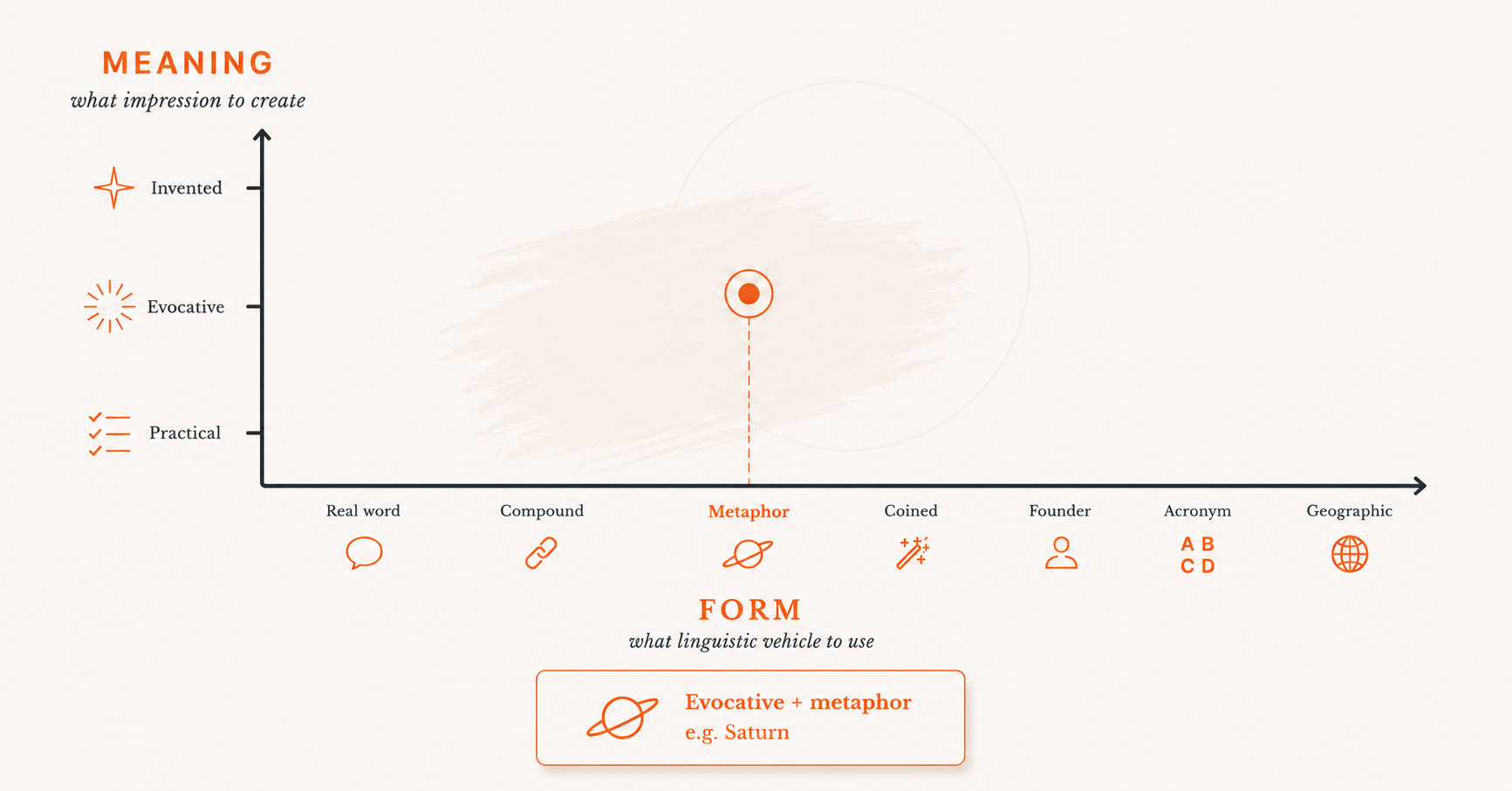
Here's what most naming articles won't tell you: naming is actually two independent decisions, not one.
The first is about meaning: What impression do we want the name to create? One of the most useful ways to think about this is along a spectrum of directness — practical, evocative, or invented.
The second is about form: What linguistic vehicle will best deliver that impression?Brand names can be constructed in several ways, as real words, compounds, metaphors, coined terms, founder names, acronyms, or geographic references.
Most people skip the first question entirely and go straight to the second. That's the mistake. It's why naming workshops tend to go in circles.
Decision 1: How direct should the name be?
There are several ways to classify brand names. One of the most useful is by how directly they communicate meaning, along a spectrum from practical to evocative to invented. This is a question of impression: what do you want the market to feel when they encounter this name for the first time? Settle it before you write a single candidate down.
Tell people exactly what you do (descriptive)
Basecamp. OpenTable. DoorDash. Dropbox.
You look at it. You know the job. Zero ambiguity, fast comprehension, no marketing budget needed to explain which category you're in.
The downside: these names are hard to trademark because you're claiming common language. And the moment you want to expand (think new product, new market, evolved model) the name becomes a cage.
"Hotels.com" cannot easily become a travel lifestyle platform. The name has already told people what it is.
Verdict: Works if you want to own a niche fast and you're confident you won't outgrow it. If you have genuine ambitions of transformation, think twice.
Suggest something without saying it directly (evocative)
Patagonia doesn't sell a region. It sells wildness, stewardship, a refusal to conform to capitalism's comfortable defaults. The name opened that door.
Notion. Stripe. Figma. Fable. These names suggest something without describing anything.
The most durable brand equity gets built here. The name grows with the brand rather than constraining it. Nike doesn't mean shoes. It means winning. That's why they can sell almost anything.
The risk: someone in the room will always say "but what does it mean?" That person is not wrong. They're just asking you to do the harder work, building meaning through experience, not etymology.
Verdict: If you're building something that wants to be bigger than a category, start here.
Invent something entirely (inventive)
Kodak. Rolex. Verizon. Häagen-Dazs, coined by founder Reuben Mattus to sound vaguely Scandinavian, despite meaning nothing in any language. Spotify.
These names come from nowhere and go everywhere.
The creative latitude is enormous. The trademark path is usually clean. The meaning-building work is entirely on you.
The trap: inventing something that sounds like every other invented name in your category. Tech, pharma, and finance are full of names ending in "-ly," "-io," "-ify," or "-ium." Inventing a name that sounds invented is not differentiation. It's conformity in costume.
Verdict: The ceiling is highest here. So is the investment required to build meaning. Only do it if you're committed to the long game.
Decision 2: What form should it take?
This is an independent decision, not a consequence of the first one. The two questions answer different things entirely.
The first question — how direct should the name be? — is about meaning: what impression do you want to create in the market?
The second question — how should the name be built? — is about form: what linguisticvehicle will best carry that impression?
They don't lead to each other. A geographic construction can be practical (Kentucky Fried Chicken) or evocative (Patagonia). A compound name can tell you exactly what a company does (Salesforce) or hint at something much larger (Facebook). A real word can describe a product or transcend it.
Most naming frameworks mislead people by presenting construction techniques as separate "types" of names, as if choosing "geographic" is a complete naming strategy rather than one half of a two-part decision. It isn't. Construction is the vehicle. Meaning is the destination. You need both.
Build it from a real word or metaphor
Amazon doesn't sell rivers. It sells everything, delivered fast, and the metaphor of the world's largest river, teeming with life, got there before the brand did. Apple didn't describe a computer. It suggested simplicity, humanity, a little rebellion. One word. Borrowed from the world. Loaded with suggestion.
Real-word and metaphorical names are among the most powerful constructions available because the word arrives pre-loaded with associations the brand didn't have to earn. The job is to choose the right associations and then live up to them — for years.
Verdict: Deceptively simple. The word does half the work. You still have to do the other half consistently.
Weld two words together (compound)
Salesforce. Facebook. Snapchat. Pinterest.
Compound names earn their place by combining two familiar concepts into something new. Done well, the combination carries more meaning than either word alone. Done lazily, it reads like a domain name someone settled for.
The test: does the combination create a new idea, or just describe the product? "Salesforce" suggests power and movement — it's evocative despite being built from plain words. "SoftwarePlatform" would just be a description wearing a compound name's clothes
Verdict: High upside when the combination sparks something. Low upside when it just stacks two obvious words.
Play with language (coined)
Krispy Kreme. Dunkin'. Fiverr. Grammarly.
These are coined words: invented or altered spellings of real words, built to be ownable and to stand out on a page. Fun. Playful. Often delicious to say out loud.
The problem: coined names built around wordplay are of their moment. The vowel-dropping that signaled digital-native cool in 2009 now signals "we made this in 2009." Clever ages faster than compelling.
There's also a professionalism ceiling. The name of your infrastructure software should probably not wink at you.
Verdict: Works in consumer spaces where playfulness is a genuine brand value, not a disguise for having no brand value. Know the difference.
Borrow a place (geographic)
Pacifico. Carolina Herrera. Savannah Bee Company. Cisco, which took its name from San Francisco, though most customers today have no idea.
Place carries meaning. It comes preloaded with texture, climate, culture, and mythology. Cisco is instructive: geographic in origin, but it functions as an invented brand because the connection to the city has long since faded. The place became a springboard, not a cage.
That's the move. The trap is the opposite, naming yourself after your founding neighborhood and then wondering why people two time zones away don't feel the love.
Verdict: Use geography when the place's meaning is genuinely yours to borrow and when the geography is mythic rather than merely literal.
Abbreviate into initials (acronym)
IBM. ESPN. LVMH. USAA.
There's weight to acronyms. They feel institutional. They signal that you've been around long enough to earn the shorthand.
The problem: you only earn the shorthand after you've built the thing. IBM was International Business Machines for decades before anyone called it IBM. The acronym came after the reputation, not before it.
A startup calling itself BXR or FLK is doing the cosplay of legacy without the legacy. Nobody knows what the letters mean. Nobody will.
Verdict: Don't choose an acronym. Let one happen to you, if it happens. That's how you know you've arrived.
Put a person on the door (founder)
Ford. Chanel. Glossier, Emily Weiss's sensibility made systematic. Illy. Martha Stewart.
When a founder's name is on the door, the customer isn't just buying a product. They're buying access to a sensibility; a set of values that lived in one person first.
This works brilliantly when the founder is genuinely distinctive and committed to staying in the work. It becomes fragile when the founder leaves, misbehaves, or grows beyond what one person can embody.
The name is also almost impossible to sell. If you build "Chen & Associates" and want to exit in ten years, the acquirer is buying a name that walks out with you.
Verdict: Use your name when you are the brand. And know that this scales horizontally, not vertically.
The thing most people get wrong
People pick names based on what they like.
They pick names in rooms with too many stakeholders, so the name that wins is the one that offends nobody … which means it excites nobody.
They pick names before they know their strategy, so the name carries no meaning because there's no meaning to carry yet.
Here's the actual order of operations:
Know who you're for.
Know what you stand for.
Know what feeling you want to create.
Then name the thing.
A name chosen after that sequence is a name that can do real work. A name chosen before it is just a word with a logo attached.
One more thing: the full potential of any name is impossible to see without the complete brand experience around it. A name doesn't exist alone. It lives inside a logo, a color, a tone of voice, a product experience, a customer service interaction, a return policy.
The brand is the system. The name is the door handle.
Pick a good door handle. But know that what matters is what's inside.
Why naming is harder than it looks
Even when you get the process right, naming is still hard.
Not because good ideas are scarce. Because good ideas that are still available are scarce. Most of the names worth wanting are already trademarked. The ones with clean URLs attached are scarcer still.
This is the part of naming that nobody warns you about going in. You can have the right strategy, the right team, the right brief, and still spend weeks finding that every name that excites the room is already owned by someone in a different industry, a different country, or a different century.
A good name has a lot of boxes to check:
Fits the brand's strategic positioning
Feels right for the brand's personality and tone
Creates the intended impression in the target market
Is easy to say, spell, and search
Avoids negative, stigmatized, or unintended associations in key markets
Has an available trademark
Has an available .com or relevant domain
That's a real list. And the more boxes a name checks, the more likely it is that someone got there first.
The right posture going in: the perfect name probably doesn't exist. If it does, it's already trademarked. Start there and the process gets more productive, not less. You're not hunting for the one right answer. You're finding the best available answer that can be made great through the work that follows.
That requires patience. It requires a team that's aligned on criteria before it's aligned on candidates. And it requires keeping expectations honest throughout, which is harder than it sounds when a CEO falls in love with a name on day two.
The names you end up with are almost never the ones you started with. Don’t think of it as failure but the process working.
Name generators are a start, not a strategy.
For DIY'ers: Shopify's generator and Namelix are solid and fast. But neither tells you what the name needs to mean. They'll hand you a 100 names that are available and pronounceable but which one signals the right position, or survives once 5 competitors are running the same prompt?
Final thought
There's no shortage of reasons to rename a company and no shortage of bad reasons to pick a name in the first place.
Whether you're figuring out how to choose a brand name for something new, or rebranding something that's outgrown what it used to be, the framework matters more than the name. Strategy first. Construction second. Creative execution third.
Get those in the right order and even a strange name can become a great brand.
Need help working through the naming process?
Let's talk.